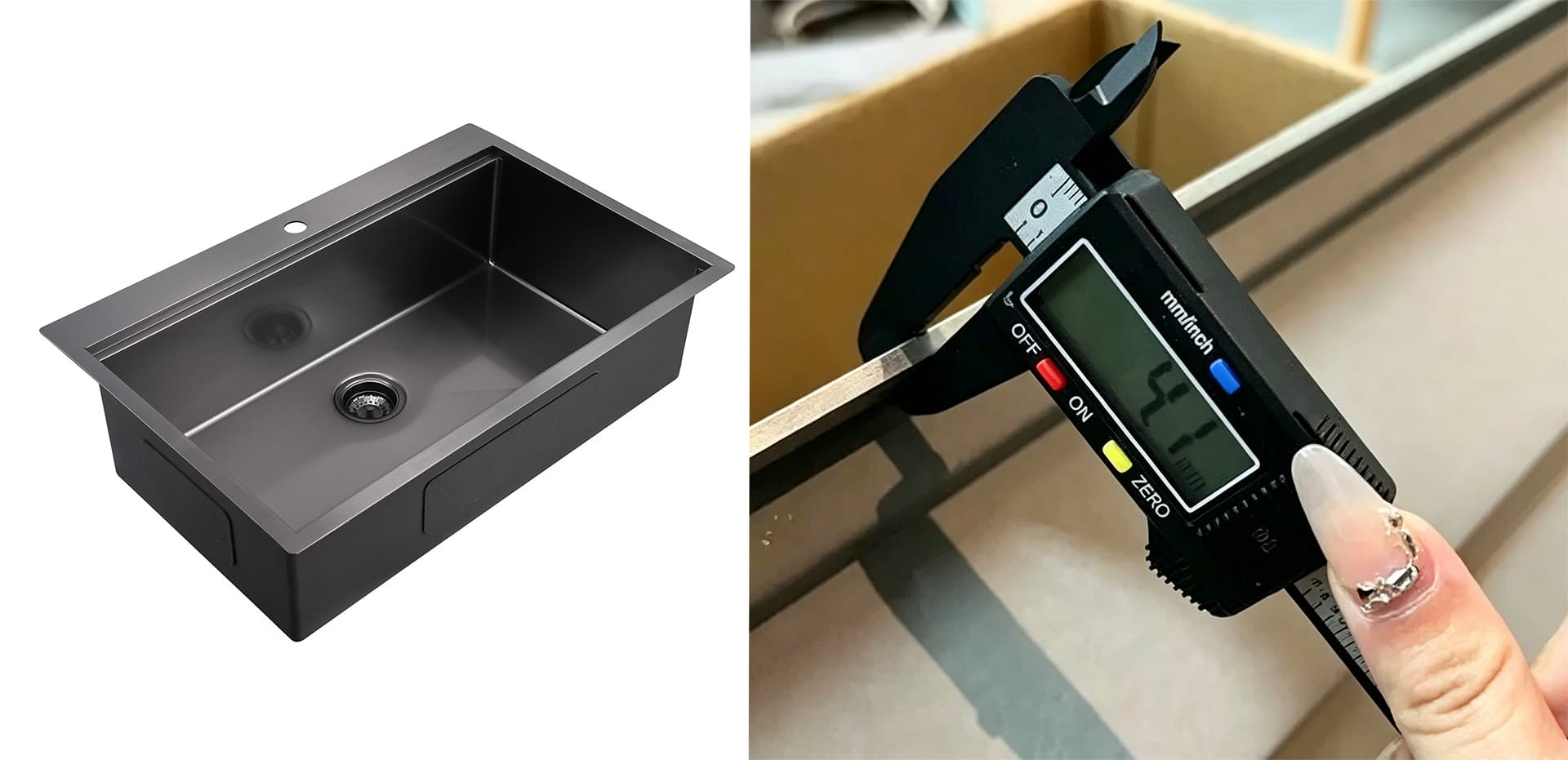
For North American brand owners, commercial project contractors and retail chain buyers, a kitchen sink is far more than a basic fixture—it directly impacts project quality, long-term maintenance costs and end-customer satisfaction. Many procurement teams struggle to tell the real difference between handmade sinks and regular drawn/stamped sinks, and often assume the gap is only about price. In reality, the two products use fundamentally different manufacturing processes, deliver vastly different durability, and serve completely different project grades. This guide breaks down exactly what handmade stainless steel sinks are, how they outperform standard drawn options, and why they are the smarter choice for high-end commercial, hospitality and branded residential projects.

First: What “Handmade Sink” Actually Means
A common misconception is that handmade sinks are assembled piece by piece by hand. This is not accurate. Modern handmade kitchen sinks are manufactured using precision industrial processes: CNC laser cutting, robotic bending and seamless laser welding of solid stainless steel plates.
The term “handmade” refers to the fact that the sink is formed by fabricating flat steel plates into shape, rather than stretching a single sheet through stamping. Most importantly, this fabrication method never compresses or thins out the steel at corners and the basin bottom. Every section of the sink retains the full original thickness of the steel plate, typically 1.2mm to 1.5mm for commercial-grade models.
")
The Core Difference: Drawn/Stamped Sinks vs. Handmade Sinks
Standard drawn sinks—also called stamped sinks—are made by pressing and stretching a single flat steel sheet into a basin shape, much like inflating a balloon. During this stamping process, the steel at the basin bottom and inner corners is forcibly stretched thinner. Most economy drawn sinks start as 0.8mm steel and end up even thinner at high-stress points.
This creates inherent weaknesses:
- Thinner corners and bottoms dent and warp easily under heavy commercial use
- Thinner steel is more prone to cracking and leaking over time
- Larger rounded corners reduce usable basin space and look less premium
Handmade sinks eliminate all these issues. Because the basin is built from cut and folded steel plates rather than stretched, wall and corner thickness remains fully consistent across the entire product. The structure is significantly stiffer and heavier, with tight small-radius corners that maximize interior space and deliver a clean, modern aesthetic preferred in high-end projects.
")
4 Key Advantages of Handmade Kitchen Sinks for Commercial & Brand Buyers
Beyond basic structural durability, well-engineered handmade sinks include purpose-built features that directly benefit B2B buyers and large-scale projects.
1. X-Groove Fast-Drainage Design
Handmade sinks often integrate an X-shaped groove pattern on the basin floor, paired with a precisely sloped base. This design directs water toward the drain much faster than standard flat-bottom drawn sinks, reducing standing water and speeding up drying after use.
For commercial kitchens, hospitality projects and high-use residential buildings, faster drainage means fewer water stains, less bacteria buildup and simpler daily cleaning. Most models use a rear-positioned 3.5-inch drain opening, which is compatible with standard North American garbage disposal units and frees up valuable under-sink storage space—a major selling point for both brand retailers and project end-users.

2. Nano PVD Surface Technology
Premium handmade sinks feature a nano PVD (Physical Vapor Deposition) surface finish that creates a lotus-leaf effect: water, oil and food residue slide off the surface easily instead of sticking and staining.
The hardness of a nano PVD surface exceeds 8H, compared to roughly 4.5H for a standard brushed stainless steel finish. This means far better scratch and abrasion resistance in heavy-use environments. For retail brands, PVD finishes also enable custom color options—such as brushed gunmetal, matte black and bronze—allowing product differentiation without sacrificing corrosion resistance. All finishes are tested to meet cUPC and CE hygiene and durability standards for the North American market.

3. Commercial-Grade 304 Stainless Steel
Quality handmade sinks are constructed from genuine 304 stainless steel, available in 16-gauge and 18-gauge thicknesses. This commercial-grade material resists scratches, stains and rust, and maintains its appearance through years of heavy use.
Unlike thin drawn sinks that chip, crack or dent under commercial conditions, solid 1.2–1.5mm handmade sinks hold up to constant pot washing, heavy cookware and regular cleaning. Basins are typically 9–10 inches deep, large enough to accommodate commercial-size pots and baking sheets. This level of robustness reduces warranty claims and after-sales service costs for brand owners and project operators.

4. 7-Piece Sound Dampening System
Noise reduction is a critical but often overlooked factor in both hospitality and high-end residential projects. Quality handmade sinks come with a heavy-duty vibration-damping coating plus a full set of 7 thick rubber sound-absorbing pads applied to the underside of the basin.
This system dramatically reduces water dripping and running noise during daily use. For hotel projects, multi-unit residential builds and premium kitchen brands, quieter sinks improve end-user satisfaction and reduce noise-related complaints. The premium build quality also reinforces a high-end brand image for retail and project clients.

Built for North American B2B Buyers: Compliance & Bulk Supply
What makes handmade sinks truly suitable for large-scale buyers is not just performance, but compliance and supply capability. Reputable manufacturers design their handmade sink lines to meet cUPC, NSF and CE certification requirements, which are mandatory for major retail chains, hotel groups and commercial construction projects across the USA and Canada.
For brand owners and OEM/ODM buyers, handmade sinks also support full customization: sizes, basin configurations, finishes, accessories and logo application. Flexible minimum order quantities and bulk pricing make them viable for both mid-size custom projects and large retail chain rollouts.

Final
Standard drawn sinks still have their place in entry-level retail and budget renovations. But for North American brand owners, commercial project contractors, e-commerce sellers and retail chains targeting the mid-to-premium segment, handmade stainless steel sinks deliver lower total cost of ownership, better compliance, stronger durability and a higher-quality end product.
The higher upfront cost is offset by longer service life, fewer warranty issues, stronger project aesthetics and better alignment with North American market standards. If you are sourcing kitchen sinks for bulk orders, custom brand programs or commercial projects, handmade stainless steel sinks are almost always the more cost-effective long-term choice.