Views: 0 Author: Site Editor Publish Time: 2026-05-21 Origin: Site
For many importers and distributors entering the North American plumbing industry, product selection often begins with appearance, pricing, and design trends. However, experienced buyers understand that compliance certification is actually the factor that determines whether a faucet can legally enter the U.S. market, pass inspection, and survive long-term commercial use.
In today’s competitive kitchen and bathroom fixture industry, certification is no longer simply a technical requirement buried in product documentation. It has become a critical business decision that directly impacts customs clearance, retailer approval, project qualification, insurance liability, and customer trust.
Many wholesalers learn this lesson the hard way. A faucet may look visually identical to a compliant model, yet still fail to enter major retail channels because it lacks proper cUPC certification, NSF testing, or lead-free verification. In some cases, non-certified products are stopped at customs. In others, they are rejected during commercial inspections or removed from projects after installation, creating expensive delays and replacement costs.
For contractors, developers, and private label brands, the risks are even greater. A single compliance issue across a hotel, apartment, or multifamily housing project can affect hundreds of units simultaneously. That means increased labor costs, damaged client relationships, and long-term reputation problems that are far more expensive than choosing a certified product from the beginning.
This guide explains the most important faucet certification requirements in the United States, including:
cUPC certification
NSF 61
NSF 372
Lead-free compliance regulations
WaterSense efficiency standards
Certification verification methods
OEM supplier evaluation strategies
Whether you are sourcing faucets for wholesale distribution, commercial construction, hospitality projects, or private label branding, understanding these certification systems helps reduce procurement risks while improving long-term market competitiveness.
Among all plumbing certifications used in North America, cUPC remains one of the most important and widely recognized standards for kitchen faucets and bathroom fixtures.
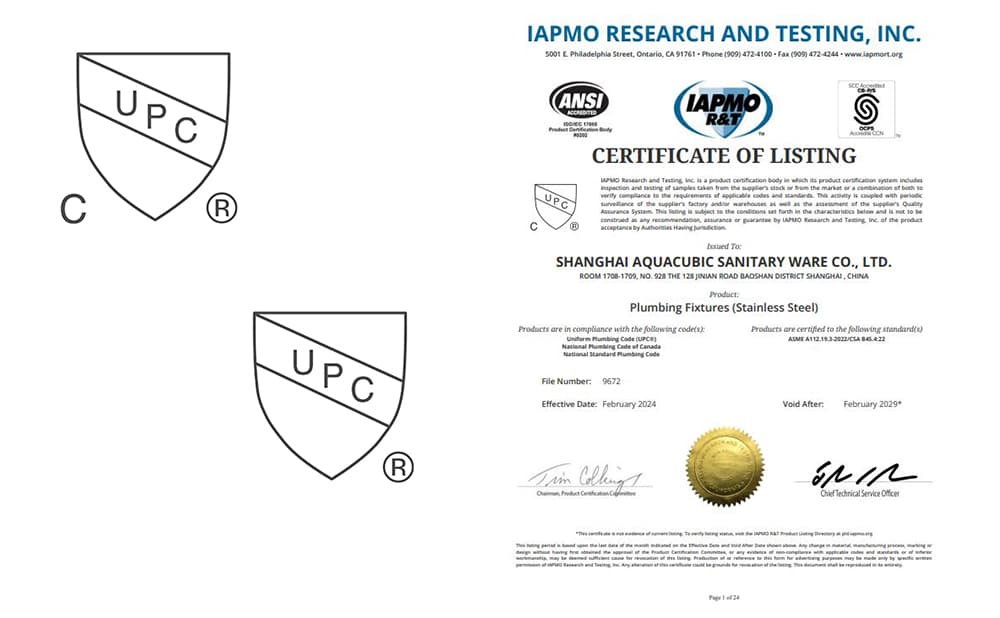
A cUPC certified faucet is a product that complies with plumbing and mechanical code requirements recognized in both the United States and Canada. Certification is typically issued through organizations such as IAPMO after extensive laboratory testing and compliance evaluation.
For North American distributors and contractors, cUPC certification serves as proof that a faucet has been tested for:
Structural durability
Leakage resistance
Water pressure performance
Flow consistency
Material safety
Plumbing code compliance
Without valid cUPC certification, many faucets cannot legally enter large-scale retail channels or commercial construction projects.
This is especially important because major North American retailers, builders, and developers increasingly require documented certification before approving suppliers. Many procurement departments now refuse to review non-certified products regardless of pricing advantages because compliance failures create legal and operational liabilities later.
According to the official IAPMO plumbing certification authority, plumbing product certification helps ensure products meet nationally recognized health and safety requirements before entering the market.
For B2B buyers, choosing cUPC certified kitchen faucets also helps simplify:
Building inspections
Contractor approvals
Import procedures
Insurance qualification
Long-term warranty management
In practical terms, certification reduces friction throughout the entire supply chain.
One of the most common misconceptions among newer importers is assuming NSF certification refers to a single standard. In reality, kitchen faucet compliance often involves multiple NSF standards that address different health and material safety concerns.
For faucets sold in North America, the two most important standards are NSF/ANSI 61 and NSF/ANSI 372.
Understanding the difference between them is essential for wholesalers, procurement managers, and OEM buyers evaluating supplier compliance documentation.
NSF/ANSI 61 focuses on drinking water safety. The purpose of this certification is to ensure faucet materials do not release unsafe levels of contaminants into potable water systems.
This standard evaluates whether components such as:
Brass bodies
Internal waterways
Valves
Coatings
Seals
Plumbing materials
could negatively affect drinking water quality during long-term use.
For residential kitchens, restaurants, hotels, healthcare facilities, and commercial buildings, this certification is extremely important because faucets interact directly with drinking water consumed daily by end users.
Products lacking NSF 61 compliance may struggle to enter:
Hospitality projects
Government developments
Healthcare construction
Large retail supply chains
Detailed information regarding drinking water safety standards can be found through the official NSF potable water safety resource.
While NSF 61 addresses drinking water safety broadly, NSF 372 specifically verifies lead-free compliance.
Under U.S. federal law, faucets connected to drinking water systems must contain no more than 0.25% weighted average lead content on wetted surfaces.
This regulation applies to:
Kitchen faucets
Bathroom faucets
Drinking water fixtures
Valves and fittings
For manufacturers, achieving NSF 372 compliance requires:
Lead-free brass formulations
Material testing
Production consistency
Third-party certification
For importers and distributors, NSF 372 provides assurance that products comply with U.S. lead-free laws and can legally enter commercial distribution channels.
As consumer awareness regarding drinking water safety continues increasing across North America, lead-free compliance has become both a legal requirement and a major marketing advantage.
Lead-free plumbing compliance is now one of the most heavily regulated areas of faucet manufacturing in the United States.
The Reduction of Lead in Drinking Water Act established strict limits for lead content in products connected to potable water systems. Faucets exceeding those limits cannot legally be sold within the U.S. market.
The current federal regulation requires:
Maximum 0.25% weighted average lead content on wetted surfaces
This requirement applies to virtually all residential and commercial faucets connected to drinking water systems.
For faucet manufacturers, compliance involves much more than simply changing raw materials. Reliable compliance requires:
Certified lead-free brass
Controlled casting processes
Laboratory verification
Quality inspection systems
Production traceability
Buyers who fail to verify lead-free compliance may face:
Customs detention
Retail rejection
Legal penalties
Product recalls
Project delays
For North American contractors and developers, using certified lead-free kitchen faucets also helps protect long-term liability exposure and customer safety expectations.
Buyers interested in modern lead-free manufacturing trends can also review the Aquacubic plumbing industry insights center for additional sourcing and compliance resources.
Beyond safety certification, water efficiency standards are becoming increasingly important throughout North America.
The EPA WaterSense program promotes high-efficiency plumbing products that reduce water consumption without sacrificing user performance.
WaterSense-certified faucets help:
Reduce water waste
Lower utility costs
Improve sustainability ratings
Support green building programs
Meet environmental procurement goals
For commercial projects and multifamily developments, water-efficient faucets may also support:
LEED-related initiatives
Government sustainability incentives
Utility rebate programs
According to the official EPA WaterSense certification program, WaterSense-certified faucets can significantly reduce household water usage while maintaining strong functionality.
This has become particularly important in regions facing growing water conservation pressures, including California, Texas, Arizona, and other high-growth markets.
Many inexperienced importers focus primarily on lowering unit costs during sourcing. Unfortunately, non-certified products often become far more expensive after shipment arrives.
The risks associated with non-compliant faucets are substantial.
Customs rejection
Failed inspections
Retailer refusal
Construction delays
Legal liability
Insurance complications
Product recalls
Brand reputation damage
For developers managing large commercial or residential projects, replacing non-compliant faucets after installation can create major operational disruptions.
A small certification oversight may eventually require:
Product removal
Reinstallation labor
Plumbing inspection repetition
Customer compensation
Schedule delays
That is why professional buyers increasingly prioritize compliance stability rather than simply choosing the lowest available factory pricing.
Professional procurement teams should never rely solely on supplier marketing materials when evaluating compliance.
Instead, certification verification should follow a structured process.
Always confirm certification directly through recognized organizations such as:
IAPMO
NSF
EPA WaterSense
Never assume packaging labels alone are sufficient proof.
Reliable faucet suppliers should provide:
Valid certification certificates
Matching model information
Laboratory testing reports
Updated compliance records
Expired or incomplete documentation should be treated as a warning sign.
Certification only matters if production quality remains stable over time.
Professional manufacturers usually maintain:
Incoming material inspection
Salt spray testing
Pressure testing
Cartridge life-cycle testing
Quality traceability systems
For buyers evaluating supplier manufacturing capability, adding a future production process video can strengthen customer trust.
Suggested anchor text placeholder: [Kitchen Faucet Manufacturing Process Video]
Certification alone does not guarantee long-term product reliability. A factory may technically pass compliance testing while still producing inconsistent faucet quality.
That is why experienced North American buyers evaluate both:
Compliance capability
Manufacturing stability
Reliable OEM faucet manufacturers typically provide:
cUPC certified products
NSF compliant materials
WaterSense options
OEM and private label support
Stable production capacity
Export documentation assistance
Consistent quality control
Aquacubic manufactures kitchen faucets specifically designed for North American compliance requirements, including cUPC, NSF, and lead-free standards. With experience supporting wholesalers, developers, contractors, and private label brands, the company supplies both residential and commercial faucet solutions tailored for long-term market reliability.
In the modern North American plumbing industry, faucet certification is no longer optional—it is foundational to legal compliance, commercial success, and long-term brand credibility.
cUPC certification, NSF 61, NSF 372, lead-free regulations, and WaterSense standards all work together to ensure faucets meet strict requirements for:
Safety
Drinking water protection
Structural reliability
Environmental efficiency
Regulatory compliance
For wholesalers, contractors, importers, and developers, prioritizing certified kitchen faucets helps reduce:
Procurement risk
Legal exposure
Warranty claims
Inspection failures
Reputation damage
At the same time, certified products increasingly improve competitiveness because modern buyers are demanding safer, more sustainable, and more reliable plumbing fixtures.
In today’s market, the most successful sourcing strategy is partnering with experienced manufacturers capable of combining compliance certification with stable production quality and long-term supply consistency.
Q1:Is cUPC certification required for kitchen faucets in the United States?
A:Yes. Most plumbing applications in North America require cUPC certification to meet building code and inspection requirements.
Q2:What is the difference between NSF 61 and NSF 372?
A:NSF 61 focuses on drinking water safety, while NSF 372 specifically verifies lead-free compliance under U.S. federal law.
Q3:What is considered lead-free for U.S. faucets?
A:Federal law limits lead content to a maximum weighted average of 0.25% on wetted surfaces connected to drinking water systems.
Q4:Can non-certified faucets be legally sold in North America?
A:In most cases, no. Non-certified faucets may fail inspections, face customs rejection, and create serious legal and commercial risks.
Q5:Why do wholesalers prefer certified OEM faucet manufacturers?
A:Certified manufacturers help reduce procurement risk, improve project approval rates, and provide more stable quality control for long-term commercial supply.