Views: 0 Author: Site Editor Publish Time: 2026-08-25 Origin: Site
For a North American retailer, contractor, or private-label brand, choosing a faucet manufacturer in China is not simply a price-comparison exercise. The real question is whether the supplier can consistently deliver compliant products, stable quality, predictable lead times, and responsive support after the container leaves the factory.
A buyer may receive three quotes for what appears to be the same kitchen faucet. One factory offers the lowest price, another has stronger certifications, and the third provides better engineering support. Six months later, the cheapest option may be generating replacement requests, installation complaints, and customer-service tickets. Suddenly, the original $2 difference per unit looks surprisingly expensive.
A reliable OEM faucet supplier should therefore be evaluated across four areas: compliance, manufacturing capability, product quality, and commercial support. China remains an important sourcing hub because its sanitaryware supply chain combines mature component networks, manufacturing scale, engineering expertise, and broad customization capability. But those advantages only matter when the buyer selects the right factory.
This guide explains how North American buyers can evaluate a faucet factory in China, verify certifications, inspect production, test samples, and build a supplier relationship designed for long-term sales rather than one successful shipment.
Before contacting manufacturers, define what you actually intend to sell.
A residential pull-down kitchen faucet for an online retailer has a very different specification from a commercial pre-rinse faucet for a restaurant project. Likewise, a premium matte-black faucet for a designer brand may require different finishing controls, packaging, documentation, and replacement-parts support than a value-oriented builder product.
A practical sourcing brief should identify:
Target country and sales channels
Residential, commercial, or project application
Faucet type and installation configuration
Required material and finish
Target flow rate
Certification requirements
Expected annual volume
Packaging and branding requirements
Spare-parts expectations
Target landed cost
This prevents a common sourcing mistake: asking factories for “your best price” before determining what “best product” actually means.
For North American projects, compliance should be discussed at the beginning, not after the prototype has already been developed. ASME A112.18.1/CSA B125.1 covers a broad range of plumbing supply fittings, including kitchen, sink, and lavatory supply fittings, and the current 2024 edition is recognized as an American National Standard.
“Certified” is one of the most overused words in international sourcing.
A supplier may show a certificate, test report, or laboratory document, but that does not automatically mean every faucet in its catalog is covered by that certification.
For North American buyers, ask the factory to provide:
Certificate number
Certification body
Exact product models covered
Applicable standard
Manufacturer name and factory address
Certification validity/status
Test reports where appropriate
Evidence that the production model matches the certified model
For faucets intended for drinking-water contact, NSF explains that NSF/ANSI/CAN 61 addresses contaminants that products can introduce into drinking water, including lead and other substances.
cUPC is particularly important for many North American plumbing applications because it demonstrates conformity through an established certification process rather than simply a manufacturer's self-declaration.
WaterSense should be treated separately. EPA explains that WaterSense-labeled products are independently certified and must be at least 20% more water-efficient while maintaining equal or better performance than conventional products.
There is also an important detail buyers often miss: WaterSense does not currently have a specification for kitchen faucets. EPA's current faucet specification applies to private lavatory faucets and accessories, while its technical guidance points buyers toward ASME A112.18.1/CSA B125.1 for kitchen faucets.
That distinction matters when a salesperson casually tells you that a kitchen faucet is “WaterSense compliant.” Ask exactly what product and certification claim they mean.
A polished catalog proves that a company can produce attractive photographs. It does not prove that it can produce 20,000 identical faucets.
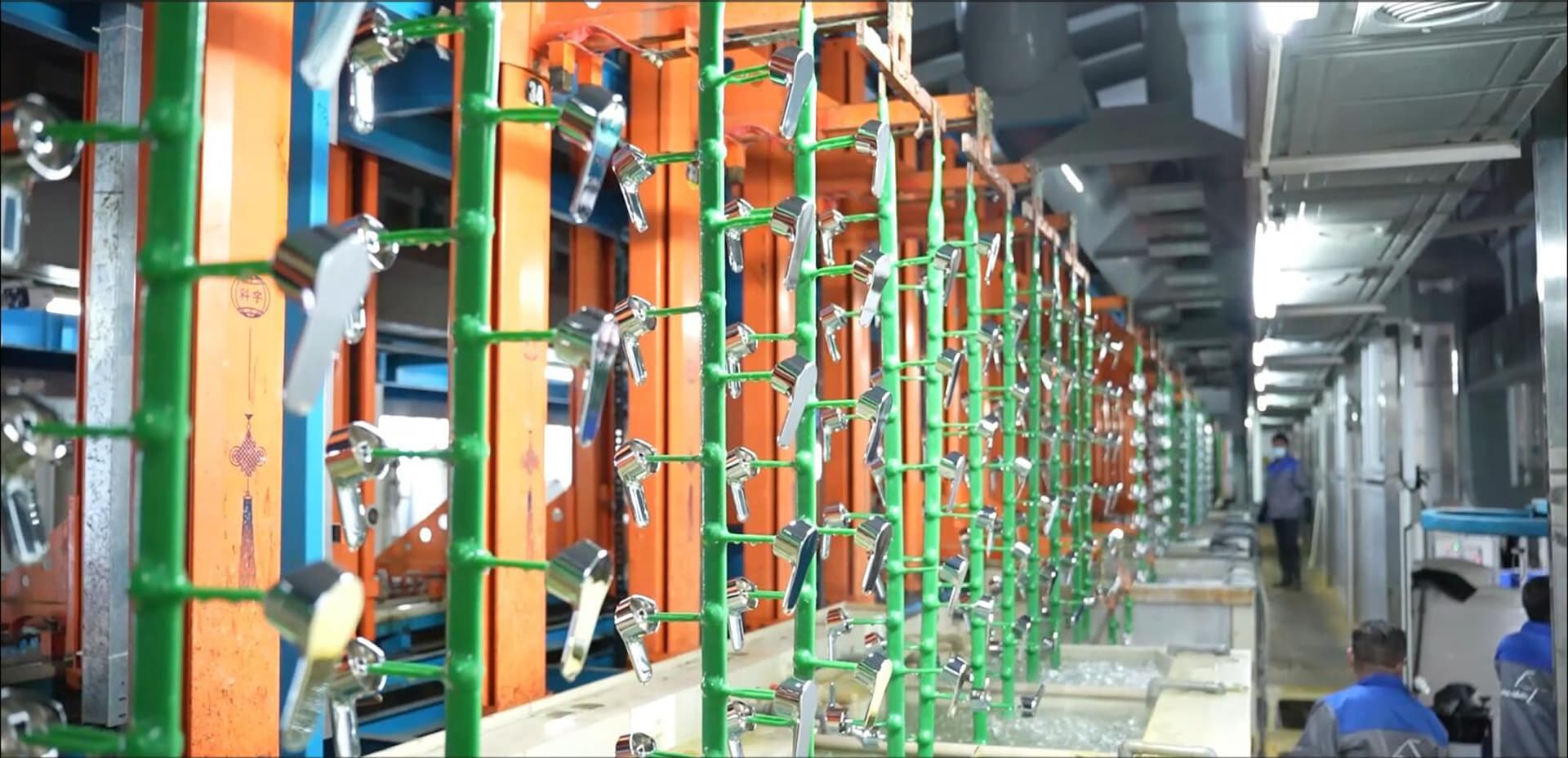
When evaluating a faucet factory in China, examine the production chain:
Audit Area | What Buyers Should Verify |
Raw materials | Brass/stainless steel specifications, supplier records, incoming inspection |
Casting | Process control, defect inspection, traceability |
CNC machining | Dimensional consistency and equipment capability |
Polishing | Surface preparation and process consistency |
Plating/PVD | Finish thickness, adhesion and corrosion testing |
Cartridge assembly | Brand, model, incoming inspection and lifecycle testing |
Hose/supply line | Material, pressure performance and certification |
Assembly | Standardized work instructions and torque control |
Testing | Leak, pressure, flow and functional testing |
Final QC | Sampling system, defect classification and records |
Packaging | Drop protection, labeling and model identification |
Traceability | Batch, production and inspection records |
The strongest factories do not depend on a final inspection to “discover” quality. They build quality into each production stage.
That distinction becomes critical at scale. A sample can be excellent while mass production quietly changes the cartridge, hose, casting supplier, plating process, or internal component. Your certification may still exist on paper, but your commercial product may no longer be identical to the one you approved.
A professional buyer should never approve a faucet solely because the sample looks good on a showroom table.
Test it under realistic conditions.
Operate the handle repeatedly. Check spray switching. Inspect the pull-down hose movement. Test the faucet at different water pressures. Look underneath the body for leakage. Examine threaded connections. Run hot and cold water. Check whether the finish remains consistent after repeated cleaning.
For a more formal evaluation, request documentation for:
Pressure testing
Leakage testing
Flow-rate testing
Cartridge cycle testing
Finish/corrosion testing
Material compliance
Hose and connector testing
Packaging testing
This is where certification and production quality meet.
A certificate demonstrates that a defined product has met applicable requirements through an accepted conformity-assessment process. It does not eliminate the buyer's responsibility to ensure that the factory continues producing the same configuration.
The better question is therefore not, “Does this factory have cUPC?”
Ask instead:
“How does this factory prevent a certified product from changing six months after I place my first order?”
That question separates a mature supplier from a certificate collector.
China's competitive advantage in faucets is not simply low labor cost.
The country's sanitaryware manufacturing ecosystem includes casting, CNC machining, polishing, plating, PVD finishing, cartridges, aerators, hoses, packaging, tooling, and logistics suppliers operating within a mature industrial network.
That ecosystem can shorten development cycles and make customization commercially practical.
For an OEM buyer, this creates several advantages:
Faster component sourcing
Greater finish selection
Flexible OEM/ODM development
Competitive tooling economics
Large production capacity
Mature export infrastructure
Access to specialized component suppliers
Easier scaling from samples to mass production
But China's supply chain also creates a temptation: choosing a supplier based entirely on factory price.
That is where procurement discipline matters.
A $28 faucet that produces 2% more defects than a $31 faucet may look cheaper on a quotation sheet. Once returns, replacement parts, customer support, freight, negative reviews, and lost sales are included, the calculation changes dramatically.
Price is a purchasing metric. Value is a business metric.
If you visit a factory—or hire a third party to inspect it—do not spend the entire tour looking at machines.
Ask management:
1. Who are your main export markets?
A supplier familiar with North American requirements should be able to discuss certification, packaging, installation, and product expectations without reading from a brochure.
2. Which processes are performed in-house?
Know what the factory controls and what it outsources.
3. How are engineering changes documented?
A component substitution should never happen casually on a private-label product.
4. How are incoming materials inspected?
Ask to see actual records rather than simply hearing “we have QC.”
5. What happens when a shipment fails inspection?
A mature factory should have a defined corrective-action process.
6. How are after-sales problems handled?
The answer reveals whether the factory sees itself as a manufacturer or merely an order processor.
For engineering projects, extend the audit beyond production. Check whether the supplier can review drawings, prepare product schedules, coordinate specifications, provide technical documentation, arrange inspections, and support installation.
That capability can be worth more than a small unit-price discount.
A manufacturer can produce an excellent faucet and still be a poor commercial partner.
North American buyers should evaluate whether the supplier understands how the product will actually be sold.
A useful OEM supplier should be able to discuss:
Local market positioning
Product differentiation
Packaging requirements
Installation instructions
Product photography and technical documentation
Spare-parts strategy
Warranty handling
Replacement procedures
Retailer or contractor feedback
New-product development
This matters because a faucet is not finished when it leaves the assembly line.
It is finished when the customer installs it successfully, uses it without problems, and can obtain support when something eventually needs attention.
For buyers building a private-label range, this sales perspective is especially important. The best manufacturer is not necessarily the factory with the largest catalog. It is the one that can help turn a technically compliant product into a commercially successful SKU.
Aquacubic approaches OEM procurement as a complete service rather than a simple manufacturing transaction. The company reports that most of its products are CE and cUPC certified and that its factory has passed QSA, CTPAT, and RESA audits. Its stated service scope covers product selection, drawing review, quotation, production follow-up, quality inspection, shipping coordination, installation support, and after-sales assistance.
Aquacubic operates production bases in China and Thailand and participates in international industry exhibitions including KBIS and KBC. Its manufacturing and service model is designed around OEM/ODM cooperation, helping partners manage product development and procurement from concept through delivery.
The commercial logic is straightforward: the lowest factory quotation is not automatically the lowest total cost. Consistent production, documented QC, certification support, engineering communication, and after-sales responsiveness can reduce hidden costs that appear much later.
For buyers evaluating suppliers, Aquacubic's OEM/ODM manufacturing journey provides a useful example of how design, production, certification, inspection, and delivery can be managed as one workflow.
Before placing a large order, score each candidate rather than relying on intuition.
Evaluation Category | Suggested Weight |
Certification & compliance | 20% |
Product quality & testing | 20% |
Manufacturing capability | 15% |
OEM/ODM engineering | 10% |
Material/component control | 10% |
Price & total landed cost | 10% |
Delivery reliability | 5% |
After-sales support | 5% |
Communication | 5% |
The weighting can change according to your business. A premium brand may give quality and design a larger share; a high-volume distributor may emphasize capacity and cost control.
The important point is to compare suppliers using the same criteria.
For buyers researching faucet manufacturing processes, Aquacubic's [faucet and sink factory overview] and [OEM/ODM faucet production] provide useful internal references for understanding how design, machining, finishing, testing, and shipment fit together.
Choosing a reliable faucet manufacturer in China is ultimately a risk-management exercise.
Certification protects market access. Factory inspection reveals manufacturing reality. Sample testing exposes performance problems. Material traceability protects consistency. Engineering support reduces development mistakes. After-sales service protects your relationship with the customer.
China offers an exceptionally mature supply chain for faucet production, but buyers should not confuse manufacturing scale with manufacturing reliability.
The strongest OEM partnerships are built around a simple principle: buy the product you can sell confidently, from the supplier you can manage confidently.
A factory that saves you $2 per faucet but creates recurring complaints is expensive. A manufacturer that costs slightly more but delivers stable quality, proper documentation, dependable delivery, and responsive support may create substantially greater long-term value.
That is the standard North American buyers should use when selecting a supplier in 2026.
Q1. What should I verify before choosing a faucet manufacturer in China?
A:Verify certification coverage, factory ownership, production capability, material specifications, component suppliers, quality-control procedures, testing records, OEM experience, production capacity, lead times, packaging, warranty policies, and after-sales support. Always compare these factors using the same evaluation criteria across shortlisted suppliers.
Q2. Is cUPC certification enough for a North American faucet?
A:Not necessarily. cUPC certification is important, but buyers should confirm the exact product models and applicable standards covered. Depending on the product and market, additional requirements may involve material safety, water efficiency, state or local regulations, and project-specific specifications.
Q3. Should I visit a Chinese faucet factory before placing an order?
A:For significant or long-term orders, an on-site audit can be highly valuable. It allows buyers to verify production equipment, material controls, testing procedures, assembly processes, warehouse conditions, QC records, and the factory's actual engineering and production capabilities rather than relying only on online presentations.
Q4. What is the biggest mistake when sourcing faucets from China?
A:The most common mistake is choosing a supplier primarily because of the lowest quotation. A lower unit price can be outweighed by certification problems, inconsistent components, defective shipments, delays, replacement costs, and customer complaints. Buyers should evaluate total landed cost and supplier reliability instead.
Q5. Can a Chinese faucet factory provide OEM and ODM services?
A:Yes. Many established Chinese faucet manufacturers provide OEM and ODM services, including custom designs, finishes, logos, packaging, components, technical drawings, and product development. Buyers should confirm which services are genuinely handled in-house and which are outsourced before signing a development agreement.