Views: 0 Author: Site Editor Publish Time: 2026-06-30 Origin: Site
Walk into almost any commercial construction meeting in North America, and you'll hear conversations about finishes, lead times, pricing, and delivery schedules. Yet experienced contractors and procurement managers often begin with a much simpler question:
"Is it certified?"
That question can determine whether a kitchen faucet or commercial sink is approved for installation, delayed at customs, rejected during inspection, or accepted without issue. In today's North American market, certifications are far more than technical paperwork—they are evidence that a product has been independently evaluated for safety, performance, durability, and compliance with local plumbing regulations.
For importers, certification also protects businesses from risks that aren't immediately visible on a quotation sheet. A faucet that saves several dollars during purchasing can become significantly more expensive once inspection failures, warranty claims, replacement labor, delayed project schedules, or customs issues are taken into account. In commercial construction, certification isn't simply about meeting regulations—it's about protecting profitability.
The importance of certification has grown even further as municipalities tighten plumbing regulations, hospitality projects pursue higher sustainability standards, and distributors seek products with fewer after-sales issues. Whether you're supplying hotel chains, apartment developments, restaurants, educational facilities, healthcare institutions, or retail plumbing stores, certified products have become the industry expectation rather than the premium option.
This guide explains the certifications that matter most—including NSF, ANSI, ASME, and cUPC—and examines how they influence procurement decisions, manufacturer selection, import procedures, project approvals, and long-term business success. You'll also learn how experienced buyers verify certification authenticity, avoid common sourcing mistakes, and evaluate manufacturers beyond simply comparing prices.
Twenty years ago, some regional distributors could still import plumbing products with limited documentation. Today's market looks completely different.
Commercial developers, engineering firms, architects, retailers, insurance companies, and government inspectors increasingly require documented compliance before products ever reach the construction site. This shift isn't driven by bureaucracy—it reflects the growing emphasis on drinking water safety, environmental responsibility, legal accountability, and product reliability.
For commercial projects, certifications influence multiple stages of the purchasing process:
Building specification approval
Municipal plumbing inspection
Import customs clearance
Product liability protection
Insurance acceptance
Retail purchasing decisions
Long-term maintenance planning
For contractors, specifying uncertified products creates unnecessary project risk. If inspectors reject installed faucets or sinks because required certifications are missing, replacing dozens—or even hundreds—of fixtures can become extremely costly.
For distributors, certification builds confidence among dealers and contractors while reducing warranty disputes and product returns.
For manufacturers, obtaining internationally recognized certifications demonstrates technical capability, production consistency, and long-term commitment to quality management.
Simply put, certifications have evolved from optional marketing advantages into competitive requirements.
Unlike some international markets where performance claims are largely manufacturer-declared, North America relies heavily on independent certification organizations.
This independent verification offers several advantages.
First, it provides confidence that published specifications have been verified through standardized testing rather than promotional materials.
Second, it creates consistency across manufacturers, allowing procurement teams to compare products using recognized technical benchmarks.
Third, certification significantly reduces legal exposure. If problems arise after installation, documented compliance demonstrates that products met recognized industry requirements when supplied.
This matters especially for:
Commercial kitchens
Hotels
Multifamily apartments
Healthcare facilities
Schools
Public buildings
Government procurement
Restaurant chains
In these environments, product reliability affects not only maintenance costs but also public safety and regulatory compliance.
One misconception among first-time importers is that certifications simply add cost.
Experienced buyers understand something different.
Certification actually reduces the total cost of ownership.
Consider two faucets.
The first costs slightly less but lacks recognized certification.
The second costs marginally more but includes complete documentation, certified materials, verified testing, and accepted plumbing approvals.
Although the certified faucet carries a higher factory price, it often produces lower lifetime costs because it minimizes:
Inspection failures
Replacement labor
Warranty claims
Customer complaints
Project delays
Product liability exposure
Viewed from this perspective, certification becomes an investment in operational stability rather than an added expense.
One of the biggest challenges facing new importers is understanding how different certification organizations work together.
Many buyers mistakenly believe NSF, ANSI, cUPC, and ASME are competing certifications.
They are not.
Instead, they perform different functions within the plumbing industry.
Some organizations develop standards.
Some perform product testing.
Others certify products after testing has been completed.
Understanding this relationship helps buyers evaluate suppliers more accurately.
The American National Standards Institute (ANSI) does not manufacture products or certify factories.
Instead, ANSI coordinates the development of voluntary consensus standards used throughout the United States.
These standards are created by industry experts, engineers, regulators, manufacturers, laboratories, and public representatives.
ANSI serves as the framework that allows different industries to work from consistent technical requirements.
When buyers encounter standards such as NSF/ANSI 61 or NSF/ANSI 372, the ANSI portion indicates that the technical requirements were developed according to nationally recognized procedures.
Recommended external reference:
Anchor text:
ANSI standards development process
Among all plumbing certifications, NSF is perhaps the most recognized for drinking water protection.
NSF develops testing standards covering:
Drinking water safety
Material safety
Lead content
Chemical contamination
Product hygiene
Public health performance
For commercial kitchen faucets, NSF certification helps verify that materials contacting potable water will not introduce harmful contaminants into the water supply.
For institutions such as hospitals, schools, universities, and food service facilities, NSF compliance is frequently specified by architects and consulting engineers.
Rather than evaluating appearance or design, NSF focuses primarily on public health protection.
Recommended external reference:
Anchor text:
NSF drinking water certification requirements
If NSF emphasizes water safety, ASME focuses on engineering performance.
The American Society of Mechanical Engineers develops standards covering:
Mechanical durability
Structural performance
Pressure resistance
Flow characteristics
Product testing methods
Commercial plumbing fixtures often reference ASME standards to demonstrate they can withstand demanding operating conditions found in restaurants, hotels, educational facilities, and healthcare environments.
For procurement teams, ASME compliance offers confidence that products have been evaluated for long-term mechanical reliability rather than simply passing visual inspection.
Recommended external reference:
Anchor text:
ASME plumbing engineering standards
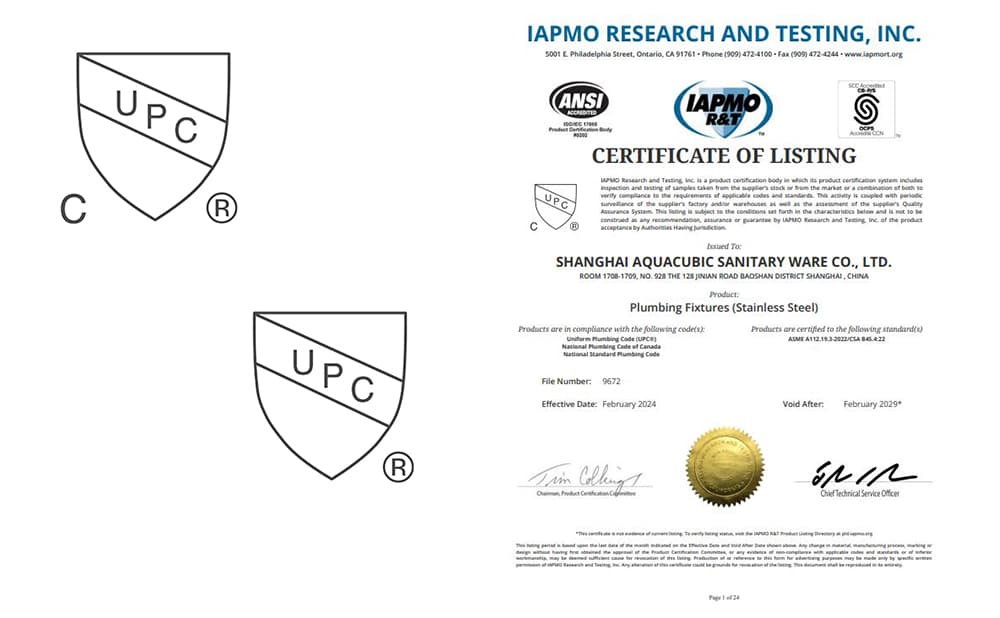
Among plumbing professionals, cUPC is one of the most frequently requested certifications for faucets and sinks entering the U.S. and Canadian markets.
Issued through IAPMO, cUPC confirms that products comply with applicable plumbing codes accepted throughout both countries.
For commercial buyers, cUPC often becomes the fastest way to demonstrate compliance during:
Building inspections
Municipal approvals
Commercial project specifications
Distribution qualification
Cross-border product sales
Products carrying cUPC certification have undergone testing for applicable plumbing performance requirements before receiving authorization to display the certification mark.
This significantly simplifies specification approval for architects, contractors, distributors, and project owners.
Recommended external reference:
Anchor text:
IAPMO cUPC certification program
Rather than replacing one another, these certifications complement each other throughout the product lifecycle.
Certification | Primary Focus | Typical Application |
|---|---|---|
ANSI | Develops technical standards | Industry framework |
NSF | Drinking water safety | Material compliance |
ASME | Mechanical performance | Structural durability |
cUPC | Plumbing code compliance | U.S. & Canada market approval |
Understanding these distinctions helps procurement teams ask more informed questions during supplier evaluation instead of simply requesting "all certifications."
Retailers rarely advertise certification as their primary selling point.
However, certification influences purchasing decisions long before customers compare finishes or prices.
Certified faucets and sinks generally provide:
Greater distributor confidence
Higher specification acceptance
Easier project approvals
Stronger contractor preference
Lower warranty risk
Better long-term brand reputation
For commercial distributors, certification often becomes an invisible sales advantage—customers may never mention it directly, yet they expect it to be there.
One of the most common misconceptions among first-time importers is that a faucet approved for residential use is automatically suitable for commercial projects. In reality, North American specifications draw a clear distinction between residential and commercial plumbing fixtures, not because they look different, but because they are expected to perform under very different conditions.
A kitchen faucet in a private home may be operated 20 to 40 times a day. The same faucet installed in a restaurant, hospital, university cafeteria, or hotel can easily experience several hundred operating cycles every day. Higher traffic means greater mechanical wear, stricter hygiene expectations, and increased liability if failures occur.
For this reason, architects and engineering consultants typically specify products that comply with recognized standards for durability, drinking water safety, plumbing performance, and local building codes. Certification therefore becomes part of the project's risk management strategy rather than simply another procurement requirement.
Commercial buyers should pay particular attention to:
Drinking water safety certification
Lead-free compliance
Pressure and flow performance
Mechanical durability
Compatibility with local plumbing codes
Long-term availability of replacement parts
Traceable certification documentation
A product that satisfies these requirements generally experiences smoother project approvals while reducing warranty claims and maintenance costs throughout its service life.
For companies importing faucets and sinks into the United States or Canada, certification has implications long before products arrive at a construction site.
Customs officials, municipal inspectors, distributors, and engineering consultants frequently request documentation confirming that imported plumbing products comply with applicable regulations.
Missing or incomplete certification may result in:
Delayed customs clearance
Additional laboratory verification
Project approval delays
Municipal inspection failures
Higher legal exposure
Increased warehousing costs
Product replacement after installation
These situations are expensive—not because certification itself is costly, but because correcting compliance issues after shipment is significantly more expensive than verifying them before production begins.
Experienced procurement teams therefore treat certification review as an early sourcing activity instead of a final administrative task.
In North America, plumbing products are increasingly evaluated not only on performance but also on legal accountability.
Commercial developers, insurance providers, and facility managers all want confidence that products installed in their buildings have been independently evaluated against recognized standards.
If an issue later arises involving drinking water contamination, premature failure, or plumbing safety, documented certification provides valuable evidence that products met accepted industry requirements at the time they were supplied.
This reduces uncertainty for:
Property developers
Hotel operators
Restaurant chains
Government projects
Educational institutions
Healthcare facilities
National retail distributors
Certification therefore protects everyone throughout the supply chain—not only manufacturers.
After reviewing hundreds of procurement cases across North America, several recurring mistakes appear repeatedly.
Some suppliers provide laboratory reports without formal product certification.
Testing and certification are not the same.
Certification requires ongoing compliance, production consistency, and authorization to use certification marks—not simply passing a single laboratory test.
Certificates have validity periods.
Buyers should always verify that documentation remains active before placing purchase orders, particularly for long-term supply agreements.
A factory may hold quality management certifications while individual products remain uncertified.
Always confirm both:
Factory qualifications
Product-specific certifications
A faucet contains numerous critical components:
Cartridges
Flexible hoses
Aerators
Water supply connectors
Brass bodies
Surface coatings
The overall product performs best when critical components are sourced from reputable suppliers and comply with relevant standards.
Saving a few dollars during purchasing can become extremely expensive after installation.
Experienced distributors evaluate:
Total lifecycle cost
Warranty rates
Inspection success
Product consistency
Supplier responsiveness
Price should support value—not replace it.
Building requirements vary across states, provinces, and municipalities.
Professional buyers confirm local code requirements before finalizing product specifications.
Perhaps the simplest—but most overlooked—step is confirming certification directly through the issuing organization.
Most major certification bodies provide searchable online databases that allow buyers to verify:
Manufacturer
Certificate status
Product model
Certification scope
Taking just a few minutes to verify documentation can prevent months of costly project delays.
Experienced procurement managers rarely rely solely on marketing brochures.
Instead, they follow a structured evaluation process.
Request current certification documents.
Confirm certificate numbers through official certification databases.
Verify that model numbers exactly match quotation documents.
Confirm certifications cover the intended market (United States, Canada, or both).
Review factory quality management capabilities.
Evaluate production consistency through factory audits or third-party inspections.
This systematic approach significantly reduces sourcing risk while improving long-term supplier relationships.
Certification should never be treated as the final stage of product development.
The most successful OEM and ODM manufacturers integrate compliance into product design from the beginning.
This means considering certification requirements during:
Material selection
Cartridge specification
Engineering design
Prototype testing
Production validation
Final inspection
Designing products around certification standards from the outset reduces redesign costs while accelerating project approvals for customers.
For private-label brands, this strategy also simplifies future product expansion because engineering platforms are already developed around recognized compliance requirements.
Certificates may open the door to North American markets, but long-term business depends on much more than documentation.
Successful distributors increasingly evaluate manufacturers based on consistency, engineering capability, after-sales support, production flexibility, and supply chain resilience.
Aquacubic has built its manufacturing strategy around these priorities. Operating dual production bases in China and Thailand, the company supports customers with diversified manufacturing capacity while maintaining internationally recognized certifications, including cUPC, CE, and WaterSense for applicable product ranges. Our certification support in the United States helps partners navigate compliance requirements more efficiently, while long-term OEM cooperation with Fortune 500 bathroom brands reflects our commitment to consistent manufacturing standards.
Rather than competing solely on factory pricing, Aquacubic focuses on delivering long-term value. Carefully selected materials, stable production processes, rigorous quality control, and responsive technical support help distributors, contractors, and retailers reduce after-sales issues, strengthen customer confidence, and improve profitability throughout the product lifecycle. Having supplied retailers, contractors, and globally recognized bathroom brands for many years, we continue expanding our global manufacturing footprint to improve supply stability and help partners remain competitive in changing international markets.
Certification has become one of the strongest indicators of supplier capability in today's North American plumbing industry. It supports market access, simplifies inspections, reduces legal risk, and strengthens confidence throughout the supply chain.
However, experienced buyers know that certifications alone do not guarantee a successful partnership. Long-term value comes from working with manufacturers that combine verified compliance with engineering expertise, stable production, responsive service, and continuous quality improvement.
Whether supplying residential developments, commercial kitchens, hospitality projects, or national retail programs, choosing certified faucets and sinks from a trustworthy manufacturing partner helps protect both project performance and brand reputation.
Ultimately, certification is not simply about meeting today's regulations—it is about building tomorrow's business with confidence.
Q1. Which certification is most important for commercial kitchen faucets in North America?
A:There is no single "most important" certification. Commercial projects typically require a combination of cUPC for plumbing code compliance, NSF standards for drinking water safety, and applicable ANSI or ASME performance standards depending on project specifications.
Q2. Can a faucet without cUPC certification be sold in the United States?
A:Requirements vary by state and municipality, but many commercial and residential projects require cUPC or equivalent approved certification to satisfy local plumbing regulations and inspection requirements.
Q3. How can importers verify whether a certification is genuine?
A:Always request the certificate number and verify it directly through the official database maintained by the issuing organization. Buyers should also confirm that product model numbers match the certified documentation.
Q4. Why do certified faucets sometimes cost more than uncertified products?
A:Certification involves product testing, ongoing factory audits, quality control, and compliance management. While initial costs may be higher, certified products generally reduce inspection delays, warranty claims, and long-term maintenance expenses.
Q5. What should distributors ask a manufacturer before placing a large OEM order?
A:Beyond certifications, distributors should evaluate production capacity, quality management systems, engineering support, replacement part availability, testing procedures, delivery performance, and experience serving North American commercial markets.