Views: 0 Author: Site Editor Publish Time: 2026-07-23 Origin: Site
Imagine you've just landed a major customer—a regional plumbing distributor, a hotel developer, or a nationwide home improvement retailer. Your kitchen faucets look outstanding, your pricing is competitive, and your delivery schedule is on point. Then comes one seemingly simple question:
"Can you provide valid cUPC certification?"
If the answer is no—or even "we're applying for it"—the conversation may end immediately.
That's because in today's North American plumbing industry, certification isn't just paperwork. It's market access. Whether you're supplying products to wholesalers, Amazon brands, builders, contractors, or retail chains, cUPC certification has become one of the first checkpoints buyers evaluate before discussing price.
For distributors importing faucets from China, understanding cUPC goes far beyond passing a laboratory test. It affects customs clearance, product liability, insurance requirements, retailer acceptance, municipal inspections, and ultimately your brand reputation. One missing certificate—or worse, one inconsistent production batch—can lead to rejected shipments, expensive recalls, delayed construction projects, and lost customer confidence.
The good news? Chinese manufacturers have evolved dramatically over the past decade. Today, many of the faucets sold by internationally recognized North American brands are produced in China under strict quality systems and internationally recognized certification programs. The real challenge isn't whether a faucet is made in China; it's whether it's manufactured under a system capable of consistently meeting North American compliance standards.
This guide explains what cUPC certification actually covers, why distributors insist on it, how leading manufacturers maintain compliance at scale, and what every importer should verify before placing an order.
Twenty years ago, many buyers viewed product certification as a competitive advantage.
Today, it's simply the minimum requirement.
Across the United States and Canada, plumbing codes increasingly require certified products to ensure public health, water safety, and installation compatibility. Contractors don't want inspection failures. Retailers don't want product returns. Developers don't want legal disputes. Everyone in the supply chain wants certainty.
That is exactly what cUPC certification represents.
Instead of asking customers to "trust" a manufacturer's claims, cUPC demonstrates that an independent third-party organization has evaluated the product against recognized plumbing standards.
For distributors, this dramatically reduces commercial risk.
Consider a hotel renovation project involving 600 guest-room faucets. If even a small percentage develops leakage problems after installation, repair costs can quickly exceed the savings achieved by purchasing inexpensive products. Labor, property damage, guest complaints, and project delays often cost far more than the faucet itself.
Professional buyers understand this equation.
Increasingly, procurement teams evaluate suppliers using a hierarchy like this:
Certification compliance
Production consistency
Quality management
Delivery capability
Price
Notice that price comes last—not because cost isn't important, but because replacing defective plumbing products after installation is one of the most expensive mistakes a distributor can make.
Many first-time importers assume cUPC simply means "approved for sale."
The reality is far more comprehensive.
cUPC certification evaluates whether a plumbing product complies with applicable North American plumbing standards covering safety, structural integrity, material quality, pressure performance, and long-term reliability.
For faucets, certification typically focuses on several major areas.
One of the most important objectives is preventing water leakage throughout the product's service life.
Laboratories simulate repeated opening and closing cycles, pressure fluctuations, and operating conditions similar to those experienced in homes and commercial buildings.
The goal isn't just proving that a faucet works on day one.
It's demonstrating that it continues working after years of regular use.
This is especially important for commercial environments such as:
Hotels
Apartment developments
Office buildings
Schools
Healthcare facilities
In these projects, thousands of daily operating cycles place significant stress on cartridges, seals, supply connections, and internal valve assemblies.
Reference link:International Plumbing Code (IPC)
North American plumbing systems operate under varying municipal water pressures.
A faucet must tolerate these conditions safely without deformation, leakage, or structural failure.
Testing evaluates how products respond to pressure significantly higher than normal household operating conditions.
For distributors, this means fewer warranty claims resulting from unexpected pressure spikes.
Certification also examines materials that come into contact with drinking water.
This includes verifying compliance with lead-content regulations and ensuring wetted components meet applicable health and safety requirements.
Material selection extends beyond the visible faucet body.
Critical components include:
Valve housings
Internal waterways
Supply connections
Brass components
Polymer parts
Sealing materials
Choosing high-quality raw materials at the beginning of production has a direct impact on certification success later.
Consumers generally notice faucet design first.
Professional buyers pay much closer attention to durability.
Laboratory testing evaluates repeated operation of handles, cartridges, moving components, and internal mechanisms to determine whether performance remains consistent throughout the expected product lifespan.
This explains why two faucets with nearly identical appearances can perform very differently after several years of use.
One may continue operating smoothly.
The other may begin dripping, developing excessive handle movement, or suffering internal wear.
The difference often originates in engineering, component selection, and manufacturing quality—not appearance.
One of the biggest misconceptions among new exporters is believing that obtaining certification automatically guarantees market success.
Experienced distributors know otherwise.
A certificate opens the door.
Consistent production quality keeps that door open.
Professional buyers increasingly ask questions such as:
Does every production batch match the certified sample?
Are cartridges sourced from approved suppliers?
Is incoming material inspection documented?
How are production changes controlled?
Can the factory provide traceability records?
Are quality audits conducted regularly?
These questions reflect an important shift in procurement philosophy.
North American buyers are no longer purchasing only products.
They're purchasing confidence.
They want suppliers capable of delivering identical quality in the first container, the fiftieth container, and the five-hundredth container.
For manufacturers, maintaining this consistency requires far more discipline than simply passing a laboratory test once.
Many distributors are surprised to learn that successful North American suppliers rarely rely on a single certification.
Instead, they build comprehensive compliance systems.
Certification | Primary Purpose | Typical Application |
|---|---|---|
Plumbing code compliance | Faucets, sinks, plumbing fixtures | |
NSF/ANSI | Drinking water safety and material performance | Water-contact components |
Mechanical performance requirements | Plumbing fixture design | |
Water efficiency | Residential & commercial faucets | |
Drinking water regulations | North American plumbing products |
Rather than viewing these certifications separately, leading manufacturers integrate them into product development from the earliest engineering stage.
Doing so reduces redesign costs, shortens certification timelines, and improves production consistency throughout the product lifecycle.
Most import problems don't happen because a faucet completely fails certification. They happen because mass production no longer matches the certified product.
That's an important distinction.
A distributor may receive a valid cUPC certificate from a supplier, only to discover months later that the factory quietly substituted an internal cartridge, changed a brass supplier, or sourced lower-cost hoses to reduce production costs. On paper, the faucet is certified. In reality, the product being shipped is no longer identical to the one originally tested.
This is one of the biggest concerns for experienced North American importers.
Below are the most common compliance failures found during factory inspections, retailer audits, and post-market quality investigations.
Imagine ordering a faucet based on an approved sample. The appearance is identical, the packaging looks the same, and even the logo hasn't changed. But hidden inside, the ceramic cartridge comes from a different supplier.
That seemingly minor change can affect:
Water pressure stability
Drip resistance
Operating life
Handle smoothness
Pressure test results
Some factories make these substitutions to reduce costs or solve supply shortages without informing customers. Unfortunately, certification applies to the approved configuration—not whatever happens to be available on the production line that week.
Professional OEM factories maintain a strict change-control system. Any modification affecting certified components must be reviewed, documented, and, when necessary, re-evaluated before production continues.
Material quality directly affects faucet performance, especially in regions with hard water, fluctuating temperatures, and high daily usage.
North American distributors often request:
Lead-free brass
SUS304 stainless steel components
Food-grade silicone seals
High-performance ceramic cartridges
Corrosion-resistant finishing
If lower-grade materials replace approved specifications, problems may include:
Early corrosion
Surface discoloration
Internal leakage
Reduced durability
Failed laboratory testing
For distributors, material consistency is just as important as certification itself.
Customers may never see the internal cartridge, but they immediately notice poor finishing.
Surface defects include:
Uneven plating
Color variation
Peeling coatings
Pitting
Scratches
Fingerprint sensitivity
Premium finishes such as matte black, brushed gold, and PVD coatings require much tighter process control than traditional chrome.
A faucet with an attractive appearance on Day One should still look attractive after years of cleaning, moisture exposure, and daily handling.
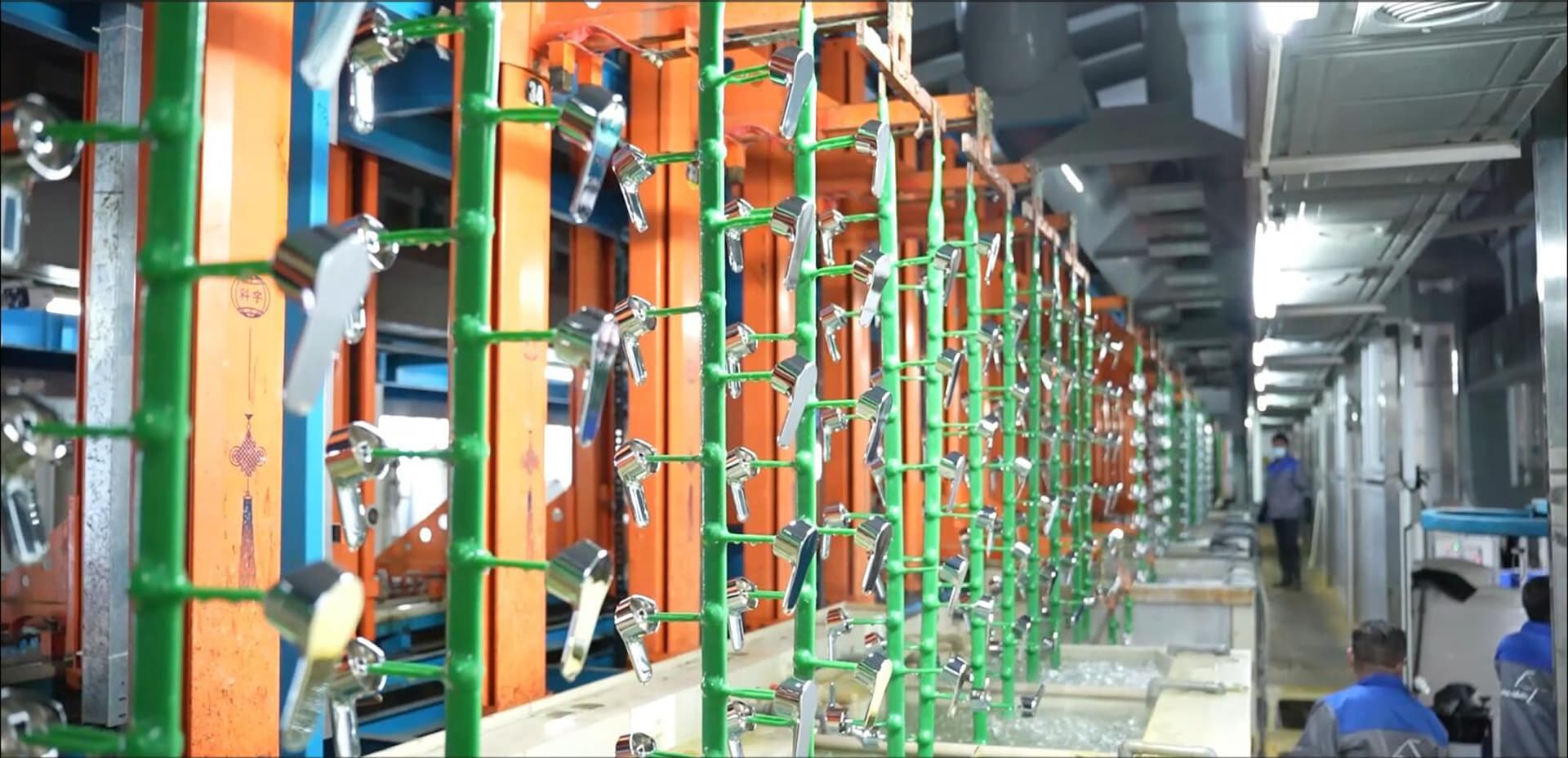
This is why reputable factories invest heavily in automated polishing, plating control, and finish inspection rather than relying solely on manual visual checks.
Many production problems begin long before assembly.
If incoming components are not inspected carefully, defects simply move downstream.
Professional factories typically inspect:
Brass composition
Cartridge performance
Aerator specifications
Hose pressure resistance
Surface finish consistency
Dimensional tolerances
Skipping incoming inspections may save time today—but usually creates warranty claims months later.
Suppose a distributor receives a customer complaint involving one production batch.
Can the factory identify:
Production date?
Raw material supplier?
Assembly line?
Operator?
Inspection records?
Without traceability, even a small quality issue becomes difficult to investigate.
Modern OEM manufacturers increasingly use digital production tracking systems to record each manufacturing stage, allowing problems to be isolated quickly instead of affecting every shipment.
Reference link:Importer guidance for product compliance
Many buyers imagine certification as a simple laboratory inspection.
In reality, the process is much more comprehensive.
Independent certification organizations evaluate both the product and, in many cases, the manufacturer's ability to produce that product consistently.
Although exact procedures vary depending on product type and certification body, testing generally includes several categories.
Test Category | Purpose | Typical Evaluation |
|---|---|---|
Pressure Testing | Prevent leakage under operating pressure | High-pressure resistance |
Endurance Testing | Simulate years of daily use | Handle and cartridge life cycles |
Material Verification | Confirm approved materials | Lead-free and wetted components |
Dimensional Inspection | Verify installation compatibility | Thread and connection accuracy |
Functional Testing | Evaluate operating performance | Flow rate, sealing, smooth operation |
The important takeaway for distributors is this:
Passing laboratory testing once is only the beginning.
Factories must continue manufacturing products that remain consistent with the approved design.
This may sound surprising, but some certified factories still produce inconsistent products.
Why?
Because certification evaluates a product sample—not every faucet that leaves the factory.
Maintaining consistency requires disciplined manufacturing systems.
Leading OEM manufacturers typically implement:
Every assembly station follows documented procedures to minimize operator variation.
Critical components such as cartridges, aerators, and hoses are purchased only from approved suppliers that meet predefined specifications.
Instead of relying on one final inspection, quality is monitored throughout production:
Incoming materials
Machining
Polishing
Surface finishing
Assembly
Water-pressure testing
Packaging inspection
This layered approach reduces the likelihood of defective products reaching customers.
Well-managed factories regularly review production records, inspection reports, and process controls to identify opportunities for continuous improvement.
Quality is treated as an ongoing system—not a one-time event.
One of the biggest misconceptions in today's market is that "Made in China" automatically means lower quality.
The reality is far more nuanced.
Many internationally recognized faucet brands source products from Chinese manufacturing partners because China has developed one of the world's most sophisticated plumbing fixture supply chains.
Advantages include:
Mature component suppliers
Advanced CNC machining
Automated polishing and finishing
Experienced engineering teams
Large-scale production capacity
Competitive costs without sacrificing technology
For example, numerous globally recognized kitchen and bathroom brands manufacture part or all of their product lines through carefully selected Chinese OEM partners while maintaining strict quality control systems.
Their competitive advantage doesn't come from choosing the lowest-cost factory.
It comes from choosing factories capable of consistently meeting North American standards.
Successful brands typically combine:
Detailed engineering specifications
Third-party inspections
Regular factory audits
Long-term supplier relationships
Stable production management
The result is consistent quality delivered at globally competitive costs.
Before placing large purchase orders, experienced importers rarely rely on certificates alone.
Instead, they conduct comprehensive factory evaluations.
Key audit areas include:
Audit Category | Why It Matters |
|---|---|
Production Capacity | Can the factory deliver on schedule? |
Quality Management System | Are processes standardized and documented? |
Certification Records | Are certificates current and traceable? |
Incoming Material Control | Are suppliers qualified and monitored? |
Laboratory Equipment | Can routine quality verification be performed internally? |
Employee Training | Are operators properly trained? |
Corrective Action System | How are quality issues resolved? |
Traceability | Can every production batch be tracked? |
These evaluations help distinguish factories that simply possess certificates from those capable of maintaining certified production year after year.
Competitive pricing always matters, but experienced distributors understand that true value extends far beyond the initial quotation. A dependable manufacturing partner should contribute to your long-term business by reducing warranty claims, improving product consistency, and supporting your customers after the sale.
Aquacubic approaches manufacturing with that philosophy. Rather than focusing solely on production volume, the company emphasizes stable quality systems, certified production, and long-term customer success. With dual manufacturing bases in China and Thailand, products certified to cUPC, CE, and WaterSense requirements, and years of OEM experience serving Fortune 500 bathroom brands in North America, Aquacubic helps distributors balance competitive pricing with dependable performance. The objective is simple: provide products that earn repeat business, minimize after-sales issues, and strengthen partners' reputation in their local markets—not merely deliver another shipment of faucets.
Finding a faucet factory with a cUPC certificate is relatively easy. Finding one that consistently manufactures products meeting that certification standard year after year is much harder.
Many North American distributors have experienced this scenario:
Initial samples pass testing.
The first shipment performs well.
Six months later, customer complaints begin appearing.
Different production batches show inconsistent cartridge performance, leaking hoses, or finish defects.
The issue is often not certification itself—it is production consistency.
When evaluating an OEM manufacturer, consider these factors beyond the certificate.
Evaluation Item | Why It Matters |
|---|---|
Stable certified supply chain | Ensures identical materials across every production batch |
Incoming material inspection | Prevents defective brass, stainless steel, cartridges, and hoses |
Production quality checkpoints | Detects defects before assembly |
Pressure testing of finished faucets | Confirms leak resistance before shipment |
Packaging quality | Reduces freight damage and warranty claims |
Long-term engineering support | Helps distributors maintain product consistency as models evolve |
For Amazon sellers and retail chains, consistency directly influences review scores and seller ratings.
For commercial distributors, consistency determines contractor confidence and repeat business.
A faucet that performs identically after thousands of installations is far more valuable than one that merely passed certification once.
Despite ongoing discussions about reshoring and diversification, China remains one of the world's largest manufacturing centers for kitchen and bathroom fixtures.
Many well-known North American faucet brands continue sourcing products or components from Chinese OEM factories because the supply chain offers advantages that are difficult to replicate elsewhere.
These advantages include:
Complete upstream component ecosystems
Advanced brass casting technology
Mature CNC machining capabilities
Automated polishing and electroplating lines
Extensive PVD finishing expertise
Highly specialized cartridge suppliers
Competitive tooling development
Faster product customization
Large-scale production capacity
The key difference between successful and unsuccessful sourcing projects is rarely the country itself.
It is factory selection.
Professional importers focus on engineering capability, process control, audit history, and quality management—not simply price.
For many distributors, the purchase price is only one part of the total cost of ownership.
Warranty claims, shipping replacements, customer complaints, delayed projects, and damaged brand reputation often cost far more than a few dollars saved during procurement.
This is why many established North American brands work with manufacturers that prioritize production consistency instead of competing solely on price.
Aquacubic follows this philosophy through its manufacturing operations in China and Thailand. Rather than pursuing the lowest production cost, the company emphasizes stable quality systems, cUPC, CE, and WaterSense certified product lines, consistent raw material sourcing, and rigorous quality inspections throughout production. Years of OEM experience serving Fortune 500 bathroom brands, distributors, retailers, and contractors have reinforced a simple principle: reliable products generate stronger customer relationships, lower after-sales costs, and healthier long-term business growth. For partners, better manufacturing quality ultimately delivers greater value than choosing the lowest quotation.
Before placing a purchase order, distributors should verify the following items.
Verification Item | Status |
|---|---|
cUPC Certification valid | □ |
Certified model matches purchased SKU | □ |
Lead-free compliance verified | □ |
NSF/ANSI requirements satisfied (where applicable) | □ |
Factory quality audit completed | □ |
Production testing procedures documented | □ |
Packaging tested for export shipping | □ |
Spare parts availability confirmed | □ |
Warranty policy established | □ |
Product traceability system available | □ |
Completing this checklist significantly reduces import risks while improving customer confidence after products enter the market.
For North American distributors, cUPC certification is far more than a regulatory requirement—it is a practical business safeguard. It helps ensure plumbing safety, simplifies customs clearance, supports code compliance, and reduces liability across residential and commercial projects. However, certification alone does not guarantee long-term product reliability. Consistent manufacturing, disciplined quality control, and transparent factory management are equally important.
As the North American market continues to prioritize compliance, durability, and brand reputation, distributors who partner with experienced OEM manufacturers gain a competitive advantage beyond pricing alone. Selecting factories that maintain certified production systems, invest in quality assurance, and support long-term product consistency ultimately leads to fewer warranty claims, stronger customer trust, and more sustainable business growth. In today's competitive marketplace, reliable manufacturing remains one of the most valuable investments an importer can make.
Q1. Is cUPC certification mandatory for selling faucets throughout North America?
A:Many U.S. states and Canadian provinces require cUPC-certified plumbing products to comply with local plumbing codes. While requirements vary by jurisdiction, distributors targeting mainstream retail or commercial markets generally treat cUPC certification as an essential market-access requirement.
Q2. Can a factory claim compliance without holding an official cUPC certification?
A:No. Genuine cUPC certification must be issued by an accredited certification body, and certified products can be verified through official certification databases. Buyers should always request documentation rather than relying solely on marketing materials.
Q3. Why do some certified faucets still experience quality problems?
A:Certification verifies that a product design meets specified standards, but ongoing quality depends on production consistency. Material substitutions, inadequate quality control, or inconsistent assembly practices can still lead to failures if manufacturing processes are poorly managed.
Q4. What should distributors evaluate besides certification when selecting an OEM supplier?
A:Beyond certifications, buyers should assess factory audits, production capacity, raw material control, testing procedures, engineering support, packaging quality, traceability systems, and long-term quality consistency to reduce warranty risks and strengthen customer satisfaction.
Q5. How can importers verify whether a faucet's cUPC certification is authentic?
A:Request the certification file, verify the certification number through the issuing organization's official database, confirm that the listed model matches the purchased product, and ensure the factory producing the goods is the same manufacturer named on the certification.